1951 Crosley Super Sport: the full story
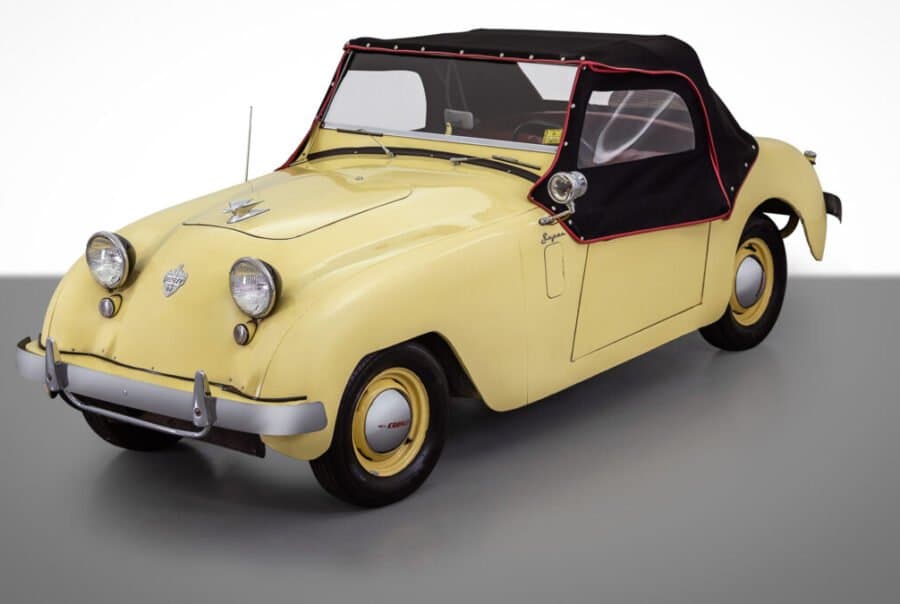
The 1951 Crosley Super Sport is one of the United States’ most fascinating little automobiles. Considering many postwar Detroit vehicles emphasized chrome and power, it is a lightweight reminder that automotive excellence is not always measured in stature. Crosley built its own path with tiny sedans, station wagons, and convertibles from 1946–1952, following an initial prewar attempt in 1939 that paused with the onset of World War II. In 1949, the company introduced the first postwar sports car with the Hotshot, a doorless roadster weighing just over 1,000 pounds before refining the concept with a Super edition, adding hinged doors and a folding top. The Super Hotshot rebranded as the Super Sports in 1951 as the definitive version of Crosley’s micro-roadster concept. This particular yellow ‘51 Super Sport with red plastic leather upholstery embodies the clever, minimalist packaging that made Crosley a cult favorite.
The car is powered by a 44-cubic-inch, four-cylinder engine with an overhead cam, fed by a naturally aspirated Tillotson single-barrel carburetor to produce 26.5 horsepower. The front-mid engine layout behind the front axle contributes to balanced weight distribution. Paired with a 3-speed manual transmission, it can go from zero-to-sixty in 20 seconds flat, which is remarkable for a car of this size. The modest 6.2-gallon fuel tank and efficient format highlight Crosley’s simplistic approach, while four-wheel caliper brakes provide competence on the road. The rear suspension combines coil springs with single leaf quarter-elliptical leaf springs, doubling as torque rods. To fuse practicality with unconventional design, the spare wheel is mounted on the down-sloping rear deck above the bumper. There is no trunk lid, but the rear stowage area is accessed by folding the seatbacks forward. Additional improvements, including a new fabric top and fresh tires on its 12-inch wheels, complement the car’s preserved originality.
Of the approximately 2,500 Crosley sports cars produced from 1949-1952, it is estimated that fewer than 400 of them were Super Sports. Despite its endearing appeal, the Super Sport was not able to combat Crosley’s already-plummeting sales, nor compete with consumer interest for larger cars created by major automobile companies, thus ceasing operations in 1952. While never produced in large numbers, its rarity only adds to the 1951 Super Sport’s charm. It is entertaining and attention-grabbing, guaranteed to draw smiles, curiosity, and admiration everywhere it goes. The car’s significance is inseparable from its creator, Powel Crosley Jr., an inventor, industrialist, radio pioneer, and former owner of the Cincinnati Reds.
Considered by many to be “The Henry Ford of Radio,” Crosley revolutionized consumer goods with his inventions. He built the world’s largest radio manufacturer in the Crosley Radio Corporation, introduced soap operas to radio broadcasting, and pioneered WLW “the Nation’s Station” as the most powerful commercial radio station in the 1930s. Beyond radio, his patented “Shelvador” put shelves in refrigerator doors, and he installed the first lights on a major league baseball field in Cincinnati that was later named after him. Crosley Jr. used his success to pursue his lifelong dream of building innovative, accessible vehicles. His automotive endeavors were nothing short of groundbreaking, as he introduced push-button car radios and the first overhead camshaft engine, as well as becoming the first American carmaker to fit all of its models with disc brakes. Crosley’s automotive venture may have been short-lived, ending in 1952 as consumer tastes shifted back toward larger cars, but the company’s legacy has only grown with time.
Today, the 1951 Crosley Super Sport is a delightful testament to the originality, clever engineering, and enduring appeal of small, joyful cars. It may not be “super” in the contemporary sense, especially among this collection’s most powerful muscle cars, but the Super Sport surely was for its time and is undoubtedly a special vehicle. A rare creation that left the automotive world far too soon, its engineering reflects Crosley’s determination to bring sports-car aesthetics and spirited driving within consumer reach at an accessible scale. This yellow open-air roadster is proof that automotive greatness is not always defined by size, cylinders, or speed, but by vision, character, and the courage to think differently.