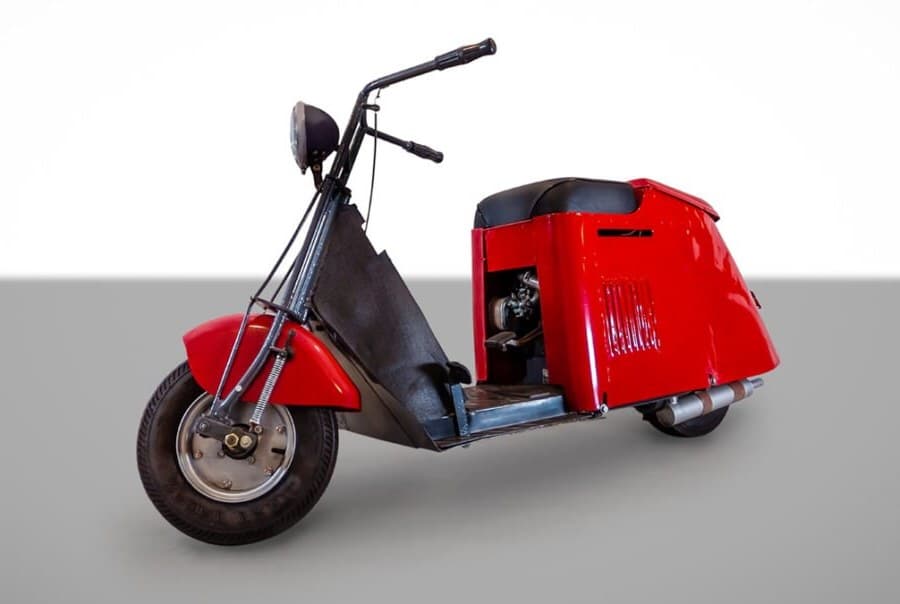
1946 Cushman Road King "Alligator": the full story
The story of the 1946 Cushman Road King “Alligator” is one of American ingenuity in the years following World War II. Founded in Lincoln, Nebraska, brothers Everett and Clinton Cushman began manufacturing Auto-Glide scooters in 1936 as a means to increase the sale of Husky engines during the Great Depression. These scooters were widely used by the United States Armed Forces before, during, and after World War II. The Alligator reflected the innovation and optimism of American design, providing affordable mobility with the long, narrow pressed-steel body that earned its reptilian nickname. The 50 series of Cushman scooters, designated Road King and Pacemaker, were introduced in 1946.
A model 52 from its very first year, this Cushman Road King “Alligator” is known for its design elements, especially the storage area behind the seat. The scooter is technically simple but cleverly engineered. It features an automatic centrifugal clutch, allowing riders to twist the right-hand grip for acceleration. Interestingly, the throttle actually twists forward during acceleration, which is opposite to the convention of most other motorcycles and scooters. The drivetrain offers high and low forward gears, reverse, and neutral, all with easy usability in mind.
With 6 horsepower on tap, a top track speed of 40 mph, and fuel economy advertised at 75 miles per gallon, Cushman promoted its scooters as delivering “penny-a-mile” operating cost. Typically weighing between 250 and 335 pounds, Cushmans were heavier and carried larger cubic capacity (up to 0.4 liters) than many European scooters, though they did not produce significantly more power. Even with its quirks, it more than compensated with its reliability and efficiency. These qualities made it that much more endearing to post-war America.
Cushman may have discontinued the 50 series in 1948, but consumer production still continued to rise following the war, peaking at about 15,000 scooters per year by the late 1950s. Cushman would, however, eventually stop building motor scooters altogether in 1965 in favor of golf carts, utility carts, and other small motorized vehicles. A 1945 Cushman Motor Scooter, much like this one, is proudly displayed in the Smithsonian National Museum of American History as part of its permanent collection. Sears even sold rebadged versions of these machines under the Allstate brand, further cementing the Road King’s place in American popular culture.
The 1946 Cushman Road King “Alligator” stands as a counterpoint to both the extravagance of coachbuilt automobiles and the minimalism of European scooters. It also “provided expanded personal mobility for two generations of young people,” according to the Smithsonian. This little icon certainly earns its place among the notable machines of the era, not through grandeur, but through its personality and historical significance.