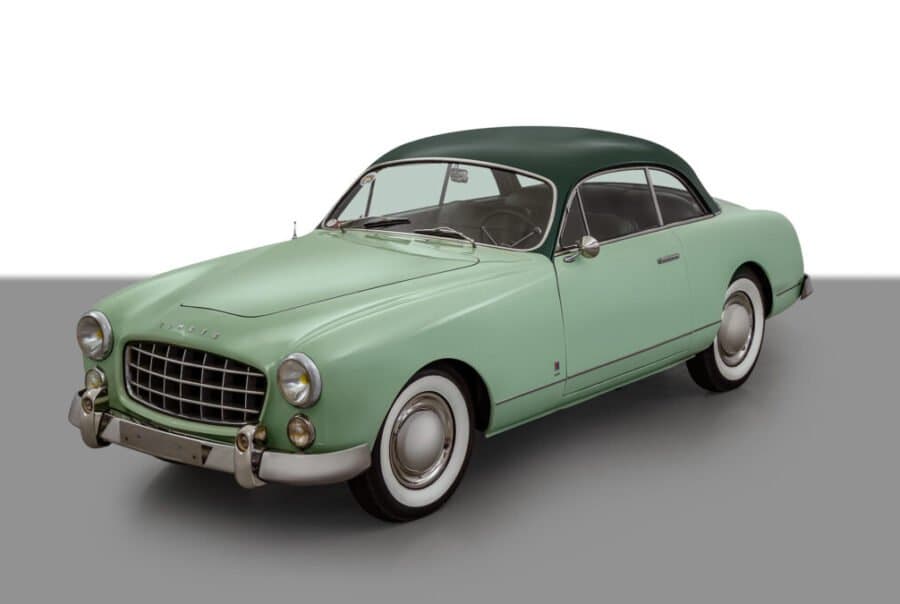
1953 Ford Comète: the full story
Built in France between 1951 and 1954, the Ford Comète was conceived as Ford's luxury model for the French market. Produced by Ford SAF with bodywork by FACEL, the Comète was championed by François Lehideux, who became president of the company in 1950. Rather than relying on Ford's design operation in Dearborn, Lehideux commissioned an independent European design through the same consortium of Stabilimenti Farina and Facel-Métalion responsible for the Simca Huit-Sport. Stabilimenti Farina, owned by Giovanni Farina, older brother of Pinin Farina, would soon be absorbed into Pininfarina, helping explain the Comète's distinctly Italian appearance. The result was a bespoke four-seat sports car that combined French coachbuilding and Italian design with Ford engineering.
At first glance, one might not immediately identify this 1953 Comète as a Ford. The elegant coachbuilt coupé has frequently been mistaken for an early Ferrari, and its connections to prominent Italian designers and coachbuilders help explain the resemblance. Early Comètes featured a single horizontal grille bar with a chromed shield or bullet at its center, along with steel wheels and chromed hubcaps. Easily one of the most attractive Fords ever offered to the public, the Comète remains remarkably overlooked.
Powering this Comète is a 2.35-liter Ford Flathead “Aquilon” V8, displacing 143.3 cubic inches. Naturally aspirated and equipped with 16 valves, the French-designed engine was originally a 2.2-liter unit produced by Ford SAF and also used in the Ford Vedette, paired with a Pont-à-Mousson four-speed manual transmission. In October 1952, for the Paris Motor Show, Ford SAF enlarged the engine from 2,158 cc to 2,355 cc, raising output from 68 to 80 horsepower. The compression ratio also rose from 6.8:1 to 7.4:1, while torque and flexibility improved and top speed increased from 81 to 90 mph. The 2.35-liter engine then became standard through the end of Comète production.
The Comète’s interior distinguishes it from an ordinary Ford. A ribbed stainless-steel dashboard, matching door handles, and a distinctive three-spoke steering wheel create a cabin that is both elegant and unmistakably of its era. Contemporary British publication Autocar recognized the car's build quality, road manners, lavish equipment, and graceful appearance. Those qualities remain central to the Comète's appeal today.
Production was limited to just 2,265 vehicles between 1951 and 1954, and with only around 50 believed to exist today, the Comète is a remarkably rare piece of Ford history. In 1954, Ford SAF was sold to Simca, and the Comète's final year of production took place under Simca, with the Simca Comète Monte-Carlo continuing to be offered until July 1955. Popular with French celebrities during its period, the Comète has remained largely in the shadow of better-known European classics. Its rarity and obscurity are part of its appeal, combining coachbuilt construction, limited production, Italian design, French craftsmanship, and American engineering into a single coupe.