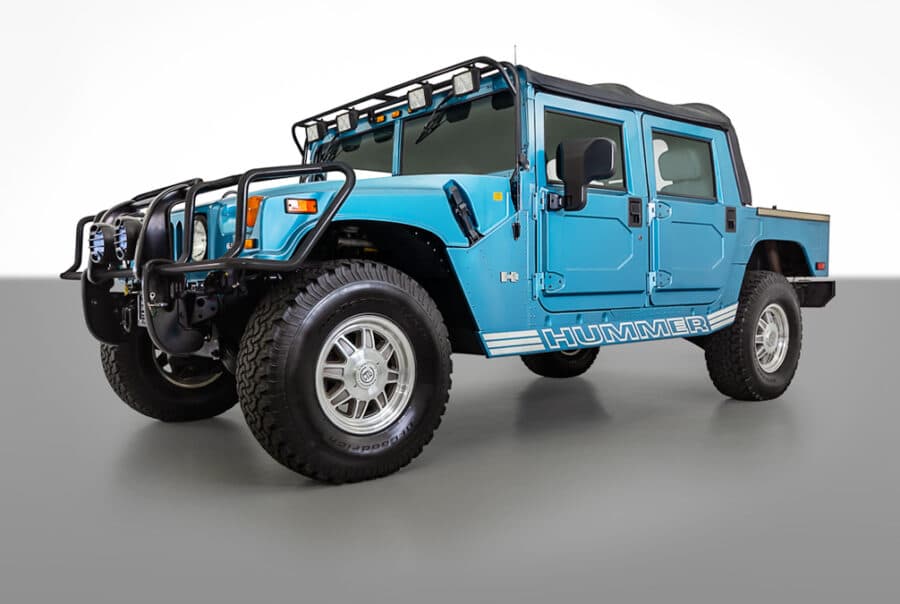
2002 Hummer H1: the full story
Derived directly from the military M998 High Mobility Multipurpose Wheeled Vehicle (Humvee), the H1 represents one of the rare occasions when a car designed for the battlefield was adapted for civilian ownership with remarkably few compromises. More than simply an off-road vehicle, it is a rare example of military-commissioned hardware successfully crafted for civilian ownership while retaining virtually all of the engineering that made it legendary.
Originally designed strictly for military service by AM General, H1 entered civilian production on March 14, 1992, following public demand generated by its highly visible role during the Gulf War and the enthusiastic advocacy of actor and future politician Arnold Schwarzenegger. Initially sold simply as the “Hummer,” the model became known as the Hummer H1 after General Motors acquired the marketing rights to the Hummer brand in 1999. Production continued through 2006, with AM General building both military Humvees and civilian H1s side-by-side at its Mishawaka, Indiana facility.
Unlike many civilianized military vehicles, the H1 retains much of its original hardware, including shared brakes, axles, frame components, and many major body panels with the military HMMWV. In fact, both vehicles were assembled on the same production line before civilian H1s were painted and finished separately. Just 704 H1s were produced for the 2002 model year, making cars from this period particularly exclusive.
Configured as a four-door soft-top, one of the final body styles offered to individual consumers, this 2002 Hummer H1 was engineered to conquer terrain that would stop virtually any other conventional production vehicle. Every element of its design serves a purpose. To withstand the rigors of extreme off-road use without sacrificing versatility, the H1 employs a heat-treated, corrosion-resistant aluminum alloy body, galvanized steel doors, rocker panel protection with dual aluminum plates, and driveline protection formed by three tubular steel cages. It also has a removable canvas top and accompanying tonneau cover. The car’s exceptionally wide track contributes to remarkable stability, while the drivetrain is packaged within a central tunnel between the seats, with portal gears raising the driveline above the wheel centers, allowing for an impressive 16 inches of ground clearance. A four-wheel independent double A-arm suspension further enhances wheel articulation and stability over challenging terrain.
The H1's advanced engineering includes inboard brakes, reducing unsprung weight and improving durability in harsh environments. Equally innovative are its run-flat tires and Central Tire Inflation System, which allows drivers to adjust tire pressure from inside the cabin to suit changing conditions, from pavement to sand, mud, or rocky trails. Exterior details including H1 badging, black door lock bezels, and halogen headlights complete the purposeful military-inspired design. A high-mounted air intake, elevated radiator, and sealed central venting system further enhance the H1's ability to operate in extreme environments, including deep-water crossings. The H1 can ford up to 30 inches of water, climb a 22-inch vertical obstacle, and tackle severe approach and departure angles of 72 and 37.5 degrees respectively. These capabilities are not marketing claims but direct results of its military origins.
The H1 is powered by the robust 6.5-liter turbocharged diesel V8, displacing 6,466 cc (395.6 cubic inches). Producing 195 horsepower and substantial torque, the engine emphasizes long-distance capability over outright speed. The powerplant traces back to General Motors’ highly successful diesel truck program, developed from the earlier 6.2-liter diesel V8 introduced in the early 1980s as an efficient alternative to gasoline-powered truck engines. Power is routed through the renowned GM 4L80-E heavy-duty four-speed automatic transmission, a gearbox derived from the Turbo-Hydramatic 400. A full-time four-wheel-drive system ensures constant power delivery to all four wheels, maximizing traction across virtually any surface. While performance was never measured in terms of outright speed, the H1's ability to travel where other vehicles simply could not remains its defining achievement.
Despite its uncompromising focus on capability, the H1's interior draws significant inspiration from commercial semi-trucks, emphasizing durability, functionality, and commanding visibility over luxury. The padded cabin featured four high-back bucket seats with four-passenger seating, while practical amenities include power windows with cruise control and flow-through ventilation. An onboard air compressor with quick-connect air lines further complements the vehicle's off-road mission. The H1 is also equipped with amenities including leather seating, running boards, and a winch package, providing a degree of comfort while preserving the vehicle's utilitarian character.
AM General's lineage traces back to Willys-Overland, the company responsible for producing the original military Jeep during World War II, making the Hummer H1 a continuation of a long tradition of military-derived vehicles that have shaped American automotive history. Unlike any of its contemporaries, no other manufacturer successfully brought a military vehicle of this scale and authenticity into civilian production while preserving so much of its original design and functionality. Produced from 1992 through 2004, and briefly revived for 2006, the H1 remained exceptionally low-volume until civilian production ended amid tightening diesel emissions regulations, while AM General continued building military Humvee variants through 2018. More than two decades after production ended, the 2002 Hummer H1 remains a lasting testament to specialized engineering, military heritage, and a truly unique chapter in American automotive history.