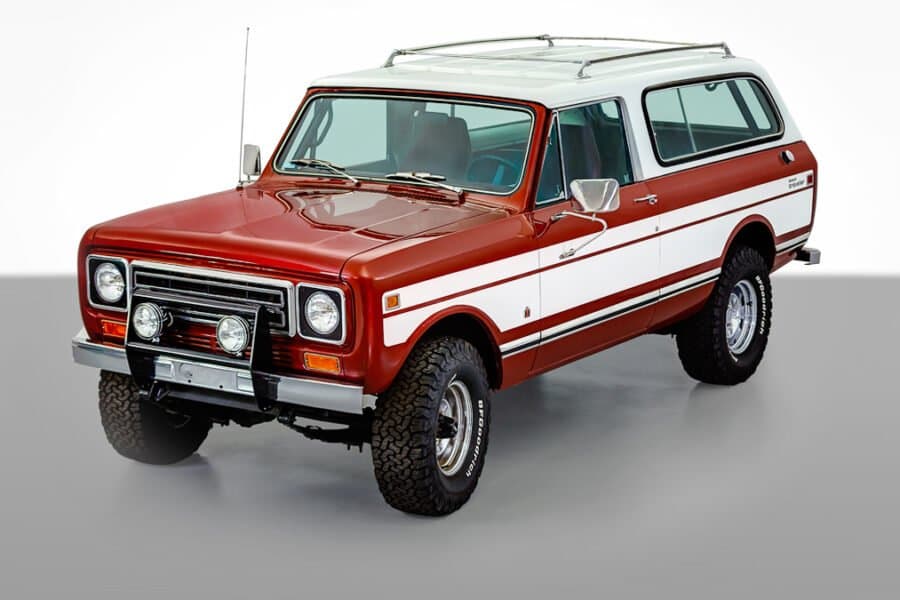
1977 International Harvester Scout Traveler: the full story
The International Harvester Scout emerged as the rugged, no-nonsense precursor to the modern SUV. Born in 1961 from an agricultural lineage of manufacturing farm machinery, construction equipment, and heavy-duty trucks, the Scout was created to challenge the Jeep CJ and offer buyers a fresh take on off-road mobility. Built in Fort Wayne, Indiana, the Scout, and later the Scout II, were produced as two-door trucks with removable hard tops and optional full-length roofs, half-cab pickups, and soft tops. Early models even featured a fold-down windshield.
While manufactured from 1971 to 1980, the Scout II design had been locked in as early as 1967. It evolved through subtle, year-specific visual changes over the years. The 1977–79 models, including this one, feature an updated grille with two large horizontal bars, three vertical supports, and the “International” nameplate centered on the left side between the familiar headlight bezels. The Scout II Terra and Traveler launched alongside one another in 1976, with both models featuring fiberglass hard tops. The main distinction between the two was the Terra’s half-cab versus the Traveler’s hatchback-type liftgate, as well as an optional third row of seats. Most Scout IIs were ordered in four-wheel drive configuration, with a select few manufactured in rear-wheel drive.
This 1977 International Scout Traveler is finished in beautifully restored Tahitian Red and Winter White. It is an extended-wheelbase variant with 18 additional inches between the door and rear wheel arch that transformed both its proportions and versatility. Under the hood sits the 345 naturally aspirated V8 (346.2 cu in), one of International Harvester’s most enduring powerplants. A Dana 2-speed transfer case, factory air, and power brakes and windows elevate this Scout into a more comfortable, livable machine without diluting the truck’s core identity. The fiberglass removable roof, unique to the Traveler and Terra models, completes the package by maintaining the adaptability that made the Scout a pioneer among multi-purpose vehicles.
A total of 39,884 Scout IIs, including the standard and all variants like the Traveler and Terra, were produced in 1977. International Harvester planned to push boundaries further with a number of Scout-inspired experiments, including minivans, station wagons, dune buggies, and even a Hurst-built special edition akin to the Hurst/Olds. However, a company strike and dwindling funds not only caused a cancellation of the expansion, but the discontinuation of the Scout altogether in October 1980.
International Harvester carved out a reputation in the early SUV movement for honesty, durability, and an unpolished brilliance that still feels refreshingly authentic today. Unlike modern supercars that command attention with speed and spectacle, the 1977 Scout Traveler charms through purpose, reliability, and integrity.