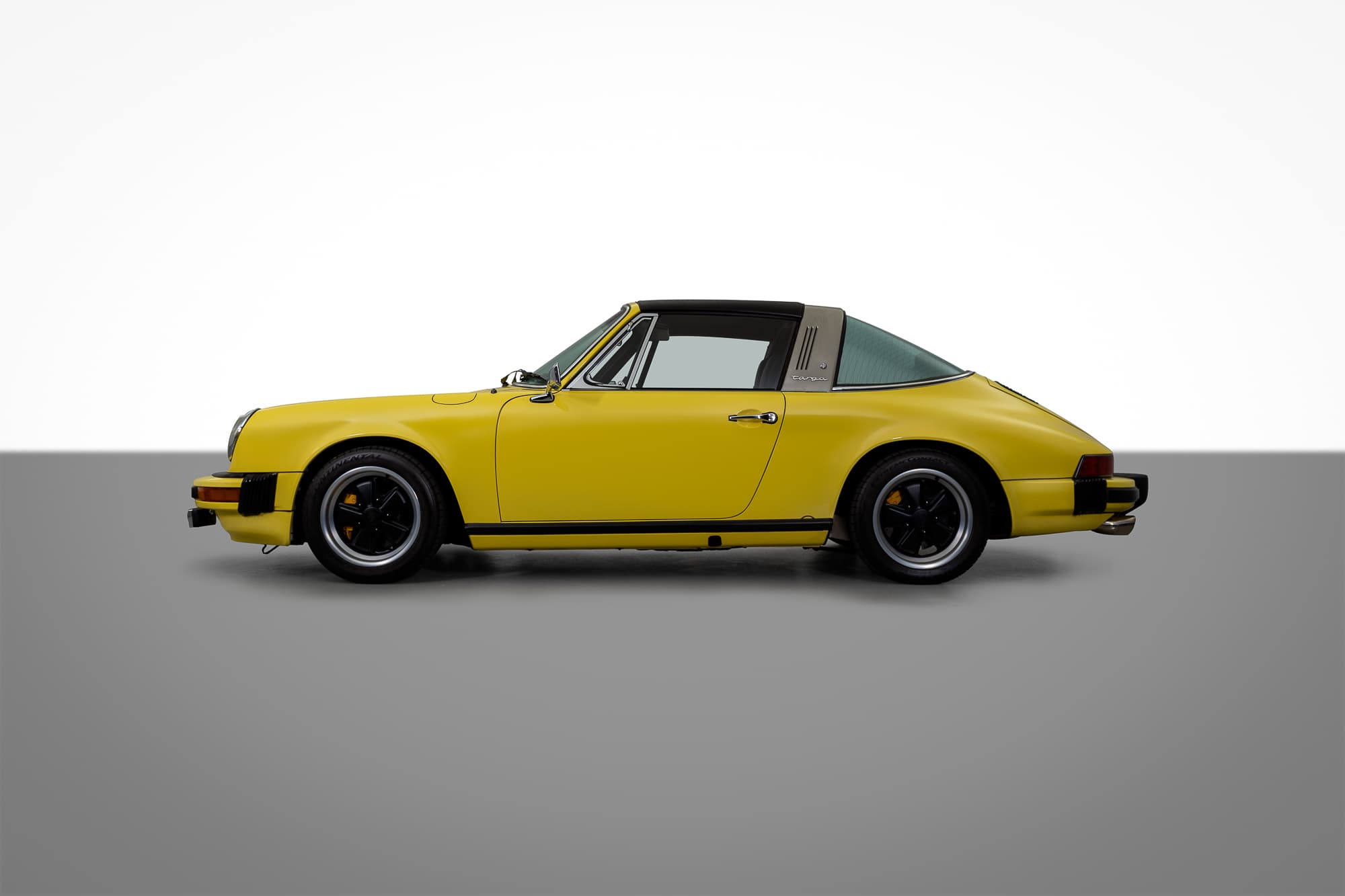
1975 Porsche 911 Targa: the full story
The 1975 Porsche 911 Targa stands as one of the purest expressions of the German company’s enduring automotive heritage. In the 1960s and 1970s, there was a lingering fear that the U.S. Department of Transportation would ban the sale of convertibles due to concerns regarding occupant safety during rollover accidents. Porsche proactively created a category of vehicles that incorporated the roofless freedom of convertibles with the safety of hard-top cars: the Targa. Defined by its removable roof panel and brushed stainless-steel roll hoop, this engineering and design solution became a Porsche hallmark. The 911 itself was conceived as a bigger, badder, faster, and more comfortable replacement for its predecessor, the 356. Porsche created an icon that would endure for nearly 60 years, with more than a million units sold.
This particular 1975 Targa clearly embodies that legacy. It received a full mechanical restoration, of which the biggest challenge was not only disassembling the vehicle, but its reassembly required extraordinary patience and expertise. The Lubeck team waited 8–10 months for the magnesium engine case halves to return from one of only two machine shops in the country capable of handling such precise work. The car’s front and rear suspension were redone, the disc-ventilated brake system upgraded, and its 2.7-liter engine rebuilt in-house to RSR specifications, with higher compression and more aggressive camshafts for added power and sharper throttle response.
The result is enhanced yet true to its roots. The 2.7-liter Boxer 6 drives the rear wheels through a 5-speed manual transmission. Porsche 911s initially had air-cooled engines, from its 1964 debut before changing to water cooling in 1998. The restoration also added a custom air-conditioning system, consisting of an original 1975 AC unit retrofitted with an electronic compressor. On the road, this two-door Targa delivers the kind of driving experience only an air-cooled 911 can. It hits the quarter-mile in just over 15 seconds at 91 mph, with a top speed of 137 mph. The entire project took a year and a half to two years to complete, a testament to the dedication required for such work.
Inside, the all-black dash features large gauges and simple controls. Unlike many modern cars with bulky center consoles, the stick shift lays bare on the floor. One job, no nonsense. With its engine mounted at the back of the car, the 911’s trunk is located in the front, which may surprise non-Porsche owners. The back seat is suited for small children or a duffle bag, and by simply removing the Targa top, backseat riders can enjoy the open-air experience. The custom upholstery elevates comfort that much more while preserving the car’s authenticity.
While some may refer to all 911s between 1974-1989 as “G-series” cars, the G-series only covered the 1974 model year. It was succeeded by the H, J, K, and subsequent series. For the 1975 model year (H Series, produced August 1974–July 1975), Porsche produced 998 examples of the 911 Targa and 1,783 of the 911 S Targa, totaling 2,781 units.
The 911’s reputation is legendary as one of the most successful racing cars. It has claimed victories at prestigious events including the Targa Florio, 24 Hours of Daytona, and 24 Hours of Le Mans. The Porsche 911 has also been celebrated on lists like Top Sports Cars of the 1970s and 1980s, #2 on Automobile Magazine’s 100 Coolest Cars, and #5 on Car of the Century. Additional achievements include World Championship for Makes awards throughout the 1970s, Motor Trend’s 2012 award for Best Driver’s Car, “World Performance Car of the Year” in 2014, and Car and Driver crowned the 911 as "the best premium sports car on the market" in 2015.
As part of the collection, this 1975 Targa offers an impressive counterpoint to the yellow 2024 Porsche 911 Targa, demonstrating how far the model has evolved while remaining faithful to its DNA. Completely different technically from its modern relative, this classic Targa serves as a bridge between eras, yet they are both united by the timeless Porsche design elements. The 1975 model year also represents a turning point: it was one of the first to carry the seminal black impact bumpers, integrating modern safety standards without sacrificing the timeless iconography.